Introduction to Marxan
Using Marxan, planners can identify an efficient system of reserve sites, or other types of zoning patterns, that include a suite of biodiversity or human use targets at a minimal cost. Marxan provides a unique method for designing site networks that is systematic and repeatable, and is the most used conservation planning tool worldwide. Introduction to Marxan courses have been offered in many locations throughout Canada and the US since 2010, and in South America since 2011. Courses are currently being planned for New York City in April, Spain in April, Vancouver in May, and Northern California in July 2012.
This hands-on technical course will provide participants with the basic knowledge and skills necessary to use Marxan in a marine conservation planning exercise. The following topics are covered in the Introduction to Marxan:
- Key concepts in systematic conservation planning
- Creating planning units
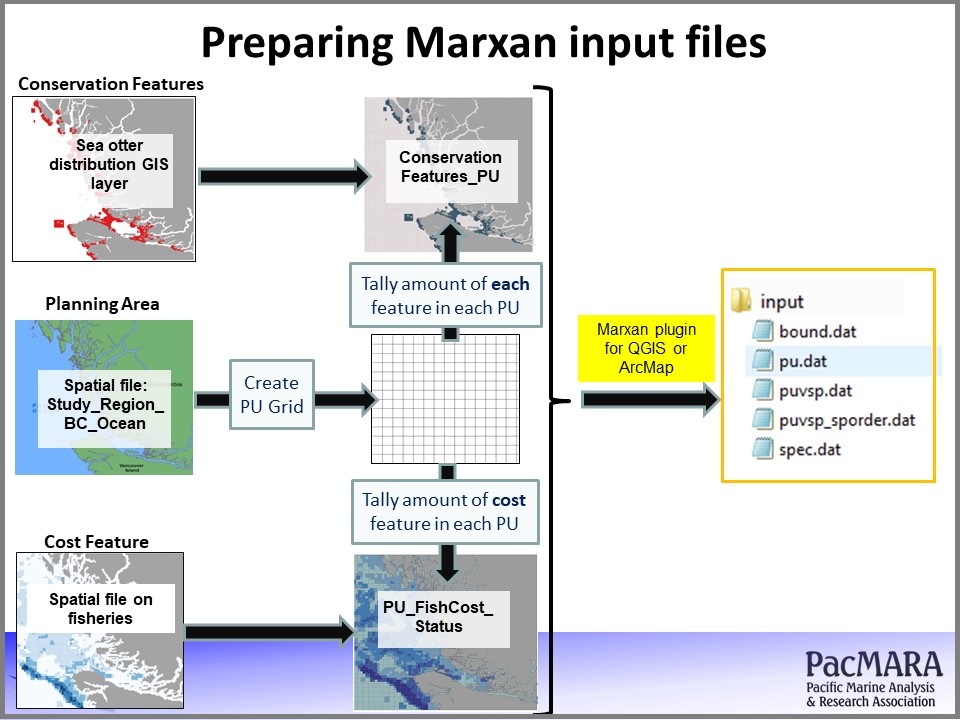
- Creating the essential Marxan input files
- Parameter setting in Marxan
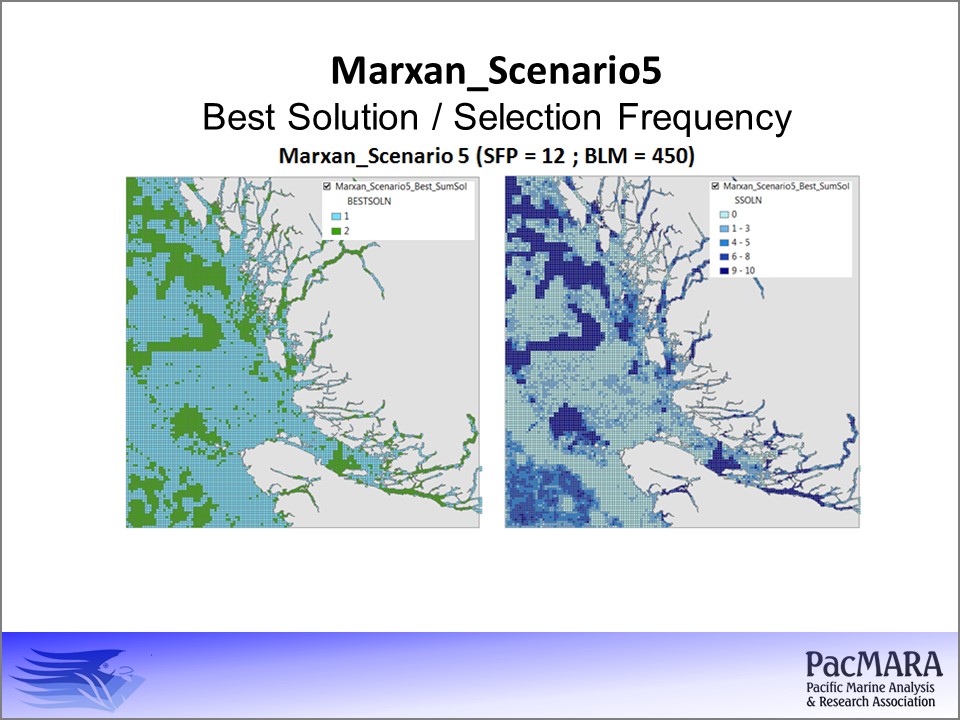
- Understanding and using Marxan results
- Zonae Cogito (decision support software)
- A brief introduction to Marxan with Zones
The course time will be split between lecture (~30%) and hands-on exercises (~70%). Experience with ArcGIS and MS Excel are prerequisite.
Click here for a general course agenda.
Click here to access PacMARA Wiki site for Marxan training resources.
Fees and Course Registration Policy
The regular* price for the course is $625 for a two-day training (including breaks and lunch). Now we offer a $30 early bird discount off all regular-priced registrants (i.e. non-students) who register up to three weeks before the course (i.e. $595 instead of $625). At the door registration will also be available in some courses.
*For students, now we offer 40% discount (i.e. $375) for the first 5 students to register and 20% discount (i.e. $500) for the next 5 students to register. After that a full registration fee will be applied.
Cancellation policy:
- Up to 3 weeks before a course: full refund less $30 administration fee;
- 1-3 weeks before a course: 50% refund;
- Less than 1 week before a course: no refund unless a replacement is found.
Click here for registration details or contact hcoleman (at) pacmara.org or nserra(at)pacmara.org.
About Marxan
Marxan (Ian Ball and Hugh Possingham, 2000) is a software program used to support the design of marine and terrestrial reserves worldwide. It is maintained by the University of Queensland in Australia.
Using Marxan, conservation planners can identify an efficient system of conservation sites that include a suite of biodiversity targets at a minimal cost. Marxan provides a unique method for designing reserves that is systematic and repeatable. It is the most utilized conservation planning tool worldwide; over 60 countries, 1100 users, and 600 organizations use Marxan to support the design of terrestrial and marine reserves. For example, it has been used to help zone the Great Barrier Marine Park, design marine reserves in the Channel Islands National Marine Sanctuary, and set spatial priorities in the Romanian Carpathians to protect large carnivores. Marxan is available at no charge from the UQ Spatial Ecology Lab: Download Marxan Software.
Click here for further Marxan information and resources.
About the Instructors
In July 2010, the first set of North American certified (by the University of Queensland) trainers were trained by Lindsay Kircher, a leading instructor from UQ. These trainers include Daniel Farr from the University of Alberta, Chris McDougall from the Haida Oceans Technical Team, Dave Nicolson from Black Coffee Consulting, Danijela Puric-Mladenovic from the University of Toronto/Ministry of Natural Resources, and Krista Royle from Parks Canada.
In December 2011, PacMARA held a Train the Trainers course in Edmonton, led by Dan Farr and Leif Olson. Five people* were successfully trained, including Norma Serra from PacMARA, Tim Wilson from Compass Resource Management Ltd, Lindsay McBlane from Parks Canada, Trevor Weins from Apropos Information Systems Inc, and Tom Habib from University of Alberta.
Please contact hcoleman (at) pacmara.org or nserra(at)pacmara.org for more information on our courses.